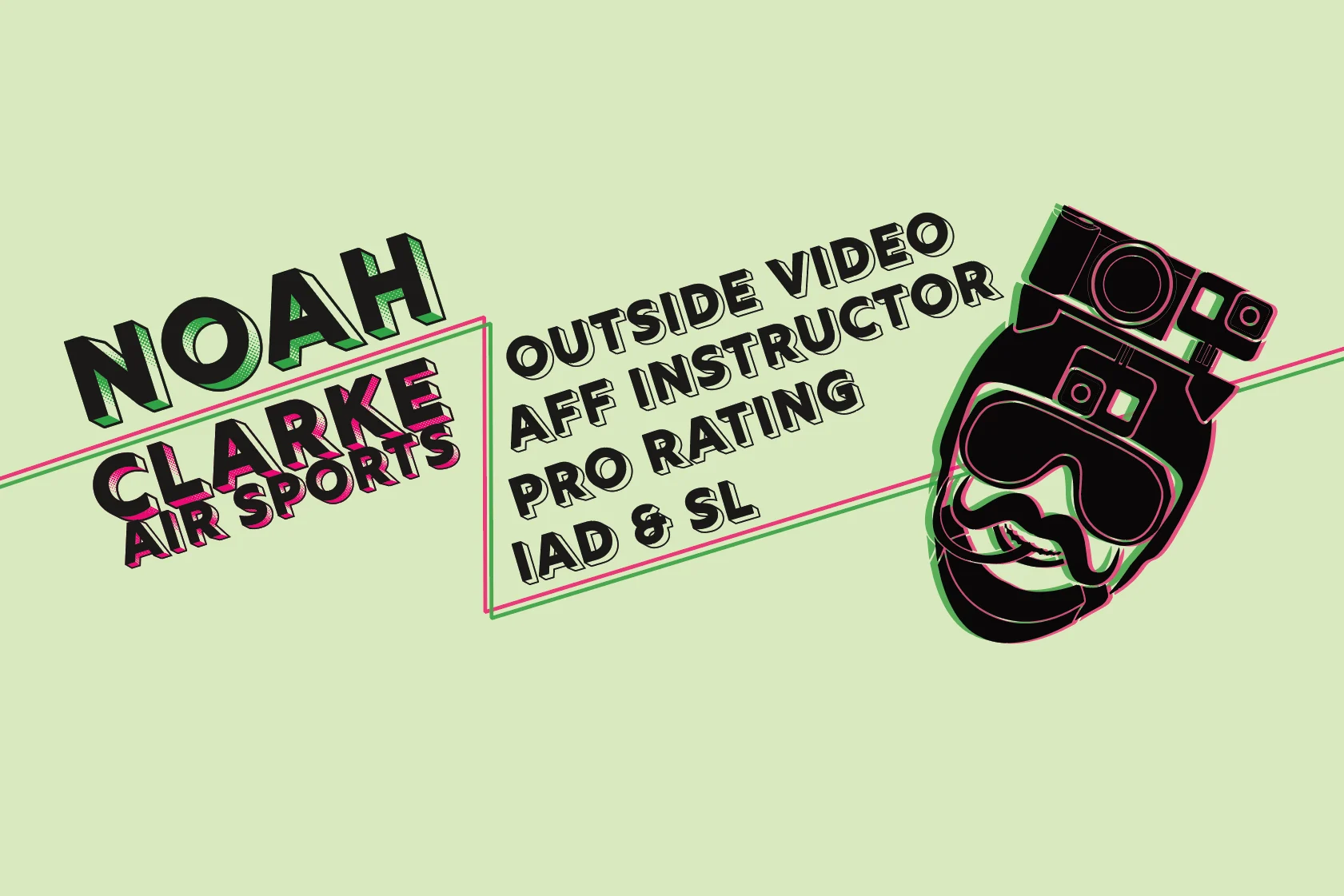
Noah Clarke is an AFF instructor at Skydive New England and runs his own business, Clarke Air Sports. He also flies camera for tandems and does demo jumps, and he splits his year between New England and Florida. I talked with him during my AFF Boot Camp about how he went from a first tandem to about 6,400 jumps.
Answers have been lightly edited for length and clarity.
Getting started
How did you first get into skydiving?
“I started in 2013, when I was 23. I’d always thought about it, and one day I asked myself why I hadn’t done it yet. Nothing was stopping me. My older sister had already done a tandem or two, and I had a job that could at least cover one.”
He wanted to go straight into AFF, but the nearest drop zone only had one AFF instructor at the time. He could wait a few months or do a tandem right away.
“I was impatient, like most of us are. So I grabbed a couple of friends from the restaurant where I worked, we all did tandems that weekend, and I came back a few months later to start AFF.”
What do you remember about your first solo freefall?
“Honestly, not much. It’s sensory overload. I remember forgetting some of the hand signals, but it was going okay, so I just kept going. What I remember most is the parachute opening and thinking, ‘Oh my God, I did it!’ Then I looked down and realized I was still 5,000 feet up. It wasn’t over yet. I still had a lot to do.”
From hobby to career
When did skydiving become something you wanted to do for a living?
“It was a natural progression.” The closest drop zone to his home in Montana was six and a half hours away. When winter came, he drove to Idaho on his days off, seven hours or more each way. He earned his license in about ten months, then moved to Idaho and lived in a house across the street from the drop zone.
He had taught before. “I used to be a snowboard instructor. And instructing was a way to jump for free and make a little money.”
Do you remember your first jump as an instructor?
“Not really. That drop zone was a little loosey-goosey with its student program, and it probably happened too soon for me. I didn’t know any better at the time. I’ve come a long way since then.”
Why start Clarke Air Sports instead of just working for one drop zone?
“In skydiving, pretty much everyone is an outside contractor.” When he moved to Florida in 2020 and went full-time, the drop zone required him to have an LLC. “I just picked a name. Then I started doing the branding because it was a good way to promote myself and get students to come to me.”
The drop zones
What makes a drop zone good?
“The people, for sure. The people are what make skydiving.” Skydive New England is his home drop zone and his favorite he’s ever worked for. “It’s got a really good balance of safety culture and good people.”
What’s it like moving between New England and Florida?
“Every time you go to a new drop zone, you have to establish yourself again.” Florida drop zones have full-time, year-round staff who get first priority, so each season down there starts slow. But the upside is the people. “So many people travel to Florida from all over the country and the world. You meet way more people, and then you see them again year after year.”
The job
AFF, tandem camera, or demos: what do you like most?
“AFF, by far. Seeing people struggle and then have that ‘aha’ moment where they finally get it is a blast.”
There is a tradeoff. Skydivers are mostly paid per jump, not by the hour. Filming tandems is easier and faster: film the jump, drop off the SD card, grab a new one, go again. AFF means 30 minutes to an hour of ground training, the jump, and then a debrief. “But teaching is way more rewarding and fulfilling.”
What’s the hardest part?
“The weather. Your whole income depends on it. A week of bad weather means a week of no money. It’s feast or famine. When it’s good, you’re making great money and having a great time. When it’s not, you’re sitting around the drop zone trying to entertain yourself.”
Is there a student whose story has stuck with you?
Last year, Noah taught a student named Brandon, who was around 70. “He was hard to teach, understandably. Less mobility, stiffer. He repeated a good handful of jumps, but he pushed through and got his license.”
Afterward, Brandon told him it had been a 50-year dream. He had made jumps around age 18 or 19 at Fort Bragg under a round military parachute and had wanted to skydive on his own ever since. “It took him 50 years, but he got it done.”
The jumps
Is there one jump that stands out?
“How I operate now is really the sum of everything I’ve seen and done.” One jump does stand out: the 2017 total solar eclipse. His team flew their plane from Idaho just over the border into Oregon and jumped during totality. “Complete darkness, the ring around the sun, watching the shadow move across the ground. It was nuts.”
What’s the scariest jump you’ve had?
“Skydiving usually isn’t actively scary. Everything happens so fast. Something bad happens, and afterward you go, ‘Oh my God, I almost died.’”
Somewhere around jump 40 or 50, at the end of a busy weekend, he was on a chaotic group jump. When it was time to separate, he tracked away but forgot about a jumper who had fallen below the formation, and that jumper tracked the same way.
“I was looking up at my deployment, and a parachute opened right underneath me. My feet and knees actually touched the top of his canopy and slid off the side. If he’d opened a few feet higher, or I’d opened a few feet lower, I probably would have hit him in freefall, and there was a good chance it would have killed us both.”
“By the time I realized what was happening, it was over. We both got away with it, we both learned from it, and hopefully we both became safer skydivers.”
Looking ahead
What’s next for you?
For about four years, Noah has been building software to help drop zones run their student AFF programs: getting videos to students, debriefing landing patterns, and tracking equipment. “Equipment has always been our bottleneck. We have a lot of students and not that many student rigs, so it’s about using every rig as efficiently as possible.”
He’ll have his own booth at the Parachute Industry Association (PIA) Symposium, the biggest skydiving trade show in the world, which happens every two years. He isn’t planning to stop jumping, though. “I don’t want to work on this so much that I’m not skydiving every day.” Instead, he’d like to visit drop zones as they adopt it, teach AFF there for a few weeks, and bring good ideas home. “Anytime I visit another drop zone, I try to learn something and steal a little bit of what they do.”
What do you wish someone had told you as a new jumper?
“Safety. But I don’t think you can just tell someone that. You either learn at a drop zone where good safety culture is ingrained from the start, or you learn by seeing the difference between places.”
His early drop zone was “a little sendy,” which gave him a lot of experience he values. “But if I’d stayed in that bubble forever, I wouldn’t know as much as I do today.” His advice: visit other drop zones and figure out where you are. Is it a strong safety culture? A little wilder, but still safe? Or just crazy, and you probably shouldn’t be there?
Anything else?
“If you’re interested in skydiving, go do it. It’s an awesome sport with an awesome community. If you go somewhere and there’s no community, go somewhere else. Not all drop zones are created equal. Community is what it’s all about.”
Thanks to Noah for taking the time to talk with me. You can find him through Clarke Air Sports.
Leave a Reply